
Hello and welcome back, friend!
For the past five episodes we’ve been laying down the principles of zero-downtime architecture like a careful mason laying foundation stones. Today we finally get to watch the house go up. And not just any house — we’re looking at a genuine small business that turned a terrifying single point of failure into a resilient, highly available cluster while cutting their costs.
I call this case study “The Vintage Vinyl Vault Migration,” and I think you’re going to love it. It’s the perfect proof that enterprise-grade resilience isn’t reserved for companies with enterprise-grade budgets.
Let me paint the picture.
The Ticking Time Bomb in the Back Office
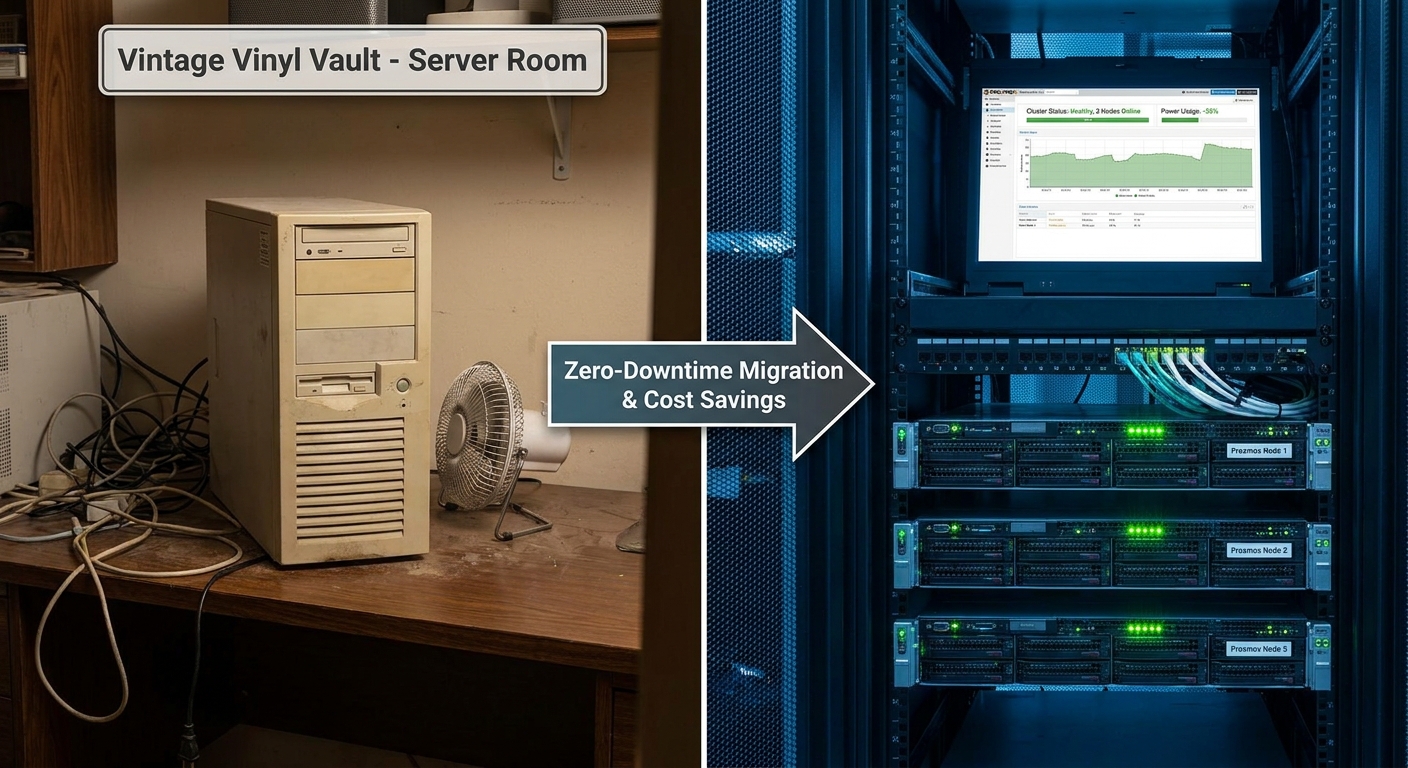
Vintage Vinyl Vault is exactly the kind of business I’ve seen dozens of times. They sell rare records online. Their entire operation — website, inventory database, order processing, customer accounts — ran on one aging server humming away in the back office.
You know the type. The machine was loud, hot, and had more miles on it than my first car. If the power supply died, the hard drive hiccuped, or Windows decided it was time for an unscheduled update, the entire business disappeared from the internet. No sales. No customer service. Just a sad “this site can’t be reached” message and a growing sense of panic.
Beyond the obvious risk, their electricity bill was eye-watering, any maintenance required taking the whole store offline, and they had zero ability to handle traffic spikes during Record Store Day or Black Friday.
They weren’t running a business. They were hostages to hardware.
Crystal-Clear Goals (And One Brutal Constraint)
When we sat down with them, their objectives were refreshingly honest:
- High availability was non-negotiable. The business could not die if a server died.
- Operational costs had to drop, especially power and cooling.
- Maintenance without downtime — they were tired of the 2 a.m. maintenance windows that felt like playing Russian roulette with their revenue.
There was one constraint that shaped everything: a very tight budget.
Expensive proprietary solutions were immediately off the table. Major cloud providers with their variable costs didn’t fit their model either. We had to be ruthlessly smart with every dollar.
This is the kind of constraint I secretly love. Nothing focuses the mind like a limited budget.
The Architecture We Built
We designed a three-node Proxmox cluster with hyper-converged Ceph storage.
Now, before your eyes glaze over, let me give you the simple version:
Imagine three friends who each own a decent car. Instead of buying one ultra-expensive supercar, they decide to work together. Through clever software, those three normal cars can now share the workload, automatically cover for each other if one breaks down, and even move passengers between moving vehicles without anyone noticing.
That’s what we built.
Proxmox gave us enterprise features — live migration, high availability, clustering — at zero licensing cost. For storage, we used Ceph to turn the local disks in each server into one giant, self-healing, redundant pool. No expensive SAN required.
For hardware, we didn’t buy one shiny new server. We bought three identical refurbished enterprise servers that were power-efficient and surprisingly punchy. The total hardware spend for all three machines was less than half of what a single new equivalent server would have cost.
My personal rule of thumb: Refurbished enterprise hardware + open-source virtualization is one of the highest-ROI combinations available to small and medium businesses right now.
The Migration: Zero Downtime or Bust
Here’s where things get fun.
My unbreakable rule in these projects is simple: never touch the live system until its replacement is fully built, tested, and bored.
We built the entire three-node cluster in parallel, completely separate from the old server. Once it was running beautifully, we performed a Physical-to-Virtual (P2V) conversion during a quiet period. Essentially we took a perfect digital snapshot of their old server and turned it into a virtual machine.
We brought the VM online on an isolated network and went full detective — testing the website, database queries, checkout flow, admin backend, everything. We were looking for even the tiniest paper cut.
Of course, because the universe has a sense of humor, we found one.
The “Everything’s Perfect… Wait, Why Is It So Slow?” Crisis
After the P2V, the site worked perfectly. But database queries were timing out. The new hardware was objectively more powerful, yet performance was worse. This is the kind of maddening problem that makes grown engineers question their life choices.
The culprit? The VM was using generic emulated network drivers.
Think of it like trying to run a world-class orchestra through a children’s toy walkie-talkie. It technically works. It just works terribly.
The fix was installing VirtIO paravirtualized drivers — basically teaching the operating system to speak the native language of the Proxmox host instead of using a clumsy universal translator. The performance difference was night and day. One reboot later and the system was flying.
This is such a painfully common gotcha that I now include it in every migration checklist. Consider this your friendly warning.
The Moment of Truth
Once performance was perfect, we scheduled a very short, clearly communicated maintenance window (more of a “brief pause” than traditional downtime).
We shut down the old physical server, did one final data sync, updated the public DNS records to point to the new cluster, and held our breath.
Then we saw it — the first live order processed on the new infrastructure. Beautiful.
But we weren’t done proving our point.
I walked over to one of the three servers, looked the team dead in the eye, and pulled the power cord.
The cluster detected the failure, automatically migrated the live virtual machine to another node, and kept serving customers. Not a single request was dropped. The website never even hiccuped.
That moment — watching the system do exactly what we designed it to do — never gets old. It’s why I do this work.
The Results That Make Accountants Smile
Here’s where the story gets really satisfying:
- The three new servers together used 35% less power than the single old beast
- Hardware cost for all three machines was less than half of a single new equivalent server
- The cost of downtime went from “thousands of dollars per hour” to effectively zero
They didn’t just improve their infrastructure. They bought genuine business insurance at a discount.
Four Lessons You Can Steal
- Open-source virtualization has grown up. Proxmox + Ceph delivers features that used to require six-figure budgets.
- Smart capital allocation beats shiny new hardware. Three good refurbished servers beat one expensive new one almost every time.
- Always budget time for the “surprise issue.” The network driver problem was completely predictable in hindsight. These moments are where experience pays for itself.
- Parallel build + rigorous testing is non-negotiable for true zero-downtime migrations. There is no clever shortcut here.
The Balanced Truth
I don’t want to paint an unrealistic picture. This approach was powerful, but it wasn’t effortless. There were late nights, moments of doubt, and plenty of documentation diving. That’s exactly why our next episode is so important.
In Episode 7, we’re going to get real about “The ‘Gotchas’ of Open-Source Virtualization: What the Documentation Doesn’t Tell You.” I’ll share the scars so you don’t have to collect your own.
The story of Vintage Vinyl Vault proves something I deeply believe: you don’t need a massive budget to build infrastructure that’s more resilient than most Fortune 500 companies had ten years ago. You just need clear priorities, methodical execution, and the right tools.
You can absolutely do this.
Now I’d love to hear from you — have you ever migrated a business off a single server? What was your scariest moment? Drop your stories in the comments. The best lessons usually come from the trenches.
Until next time, keep building things that don’t break.
— Your mentor in the server room
Episode 7 drops soon. You won’t want to miss it.