
Hello and welcome to the very first episode of Architecting Zero Downtime Infrastructure!
I’m Paul, and I’m genuinely thrilled you’re here. Over the coming weeks, we’re going on a practical, no-fluff journey together into building infrastructure that just doesn’t fall over. Think of this series as your friendly, experienced mentor in the corner of the room—someone who’s been through the wars and wants to save you some scars.
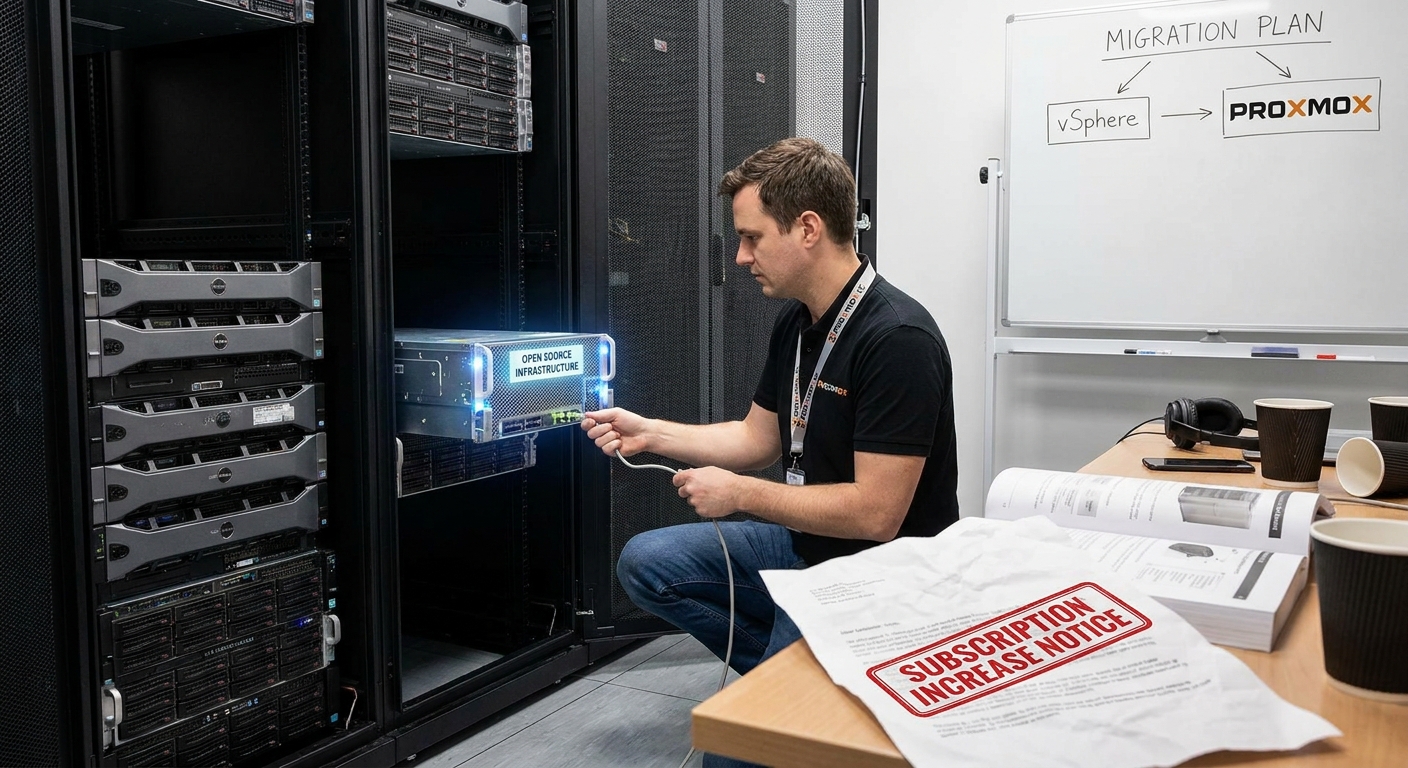
Today we’re starting with a topic that’s been shaking the IT world like a 7.5 magnitude earthquake: the VMware Exodus.
If you’ve been anywhere near Reddit, Spiceworks, or a data center hallway lately, you’ve felt the tremors. Long-time VMware faithfuls are suddenly asking the question they never thought they’d ask: “Is it time to leave?”
Let’s talk about why this is happening, what it actually means, and why — despite all the chaos — I’m weirdly optimistic about what comes next.
The Acquisition That Changed Everything
For nearly two decades, VMware wasn’t just a hypervisor. It was the hypervisor. The safe choice. The one you built your career on. It was the dependable minivan of the data center world — maybe not sexy, but it got the whole family (and all their luggage) where they needed to go.
Then Broadcom acquired VMware.
The changes didn’t trickle in. They hit like a freight train.
First, perpetual licenses were eliminated. That model you loved — buy it once, own it forever, pay reasonable support — was unceremoniously retired. In its place came mandatory subscriptions. And not just any subscriptions. Many organizations discovered they were being herded toward the full VMware Cloud Foundation bundle, whether they needed the enterprise networking and storage components or not.
It’s the IT equivalent of going to buy a sandwich and being told you must purchase the entire franchise’s catering package.
The Pain Points Nobody Saw Coming
The new per-core subscription model turned financial forecasting from a calm spreadsheet exercise into something resembling educated gambling. Small and medium businesses, schools, and non-profits got hit especially hard. What used to be predictable became opaque and significantly more expensive.
Then came the elimination of the free ESXi hypervisor. For countless admins, that free tier was how we learned, how we built homelabs, and how we tested crazy ideas on weekends. Pulling that away felt like someone burning the ladder after they’d already climbed it.
But the real damage wasn’t just financial.
Broadcom terminated thousands of partner agreements almost overnight. The local VMware experts and trusted consultants that businesses relied on? Many suddenly found themselves on the outside looking in. The vibrant VMUG community and forums that once felt like a shared journey shifted toward frustration and distrust.
I’ve talked to dozens of seasoned admins who described the same feeling: “It’s not just a tool anymore. It feels personal.”
The Opportunity Hiding in the Rubble
Here’s where my optimism kicks in.
Every seismic disruption creates space for something better. This isn’t just about escaping bad licensing terms. This is a rare chance to step back and consciously redesign what your infrastructure looks like for the next decade.
The conversation has beautifully shifted from “Why are we leaving VMware?” to the much more interesting question: “Where should we actually go?”
While there are several worthy alternatives (Hyper-V in Windows-heavy shops, KubeVirt for the deeply container-native crowd), the real groundswell is happening in the open-source space — specifically around two platforms: Proxmox VE and XCP-ng.
Today I want to focus on the one that’s been turning more heads than any other.
Why Proxmox VE is Getting So Much Attention
Proxmox VE feels like it was designed by someone who actually listened to frustrated VMware admins.
It’s built on Debian Linux (which many of us already know and love) and gives you something VMware used to charge serious money for: a genuinely unified experience. You get full KVM virtual machines and lightweight LXC containers, all managed from the same clean, web-based interface.
High-availability clustering? Included.
Live migration between hosts? Included.
Central management? Included.
No separate vCenter license. No “enterprise plus” tier hiding the good stuff. It’s all just… there.
I’ve seen battle-hardened VMware veterans fire up a Proxmox cluster for the first time and literally say, “Wait… that’s it?” The first time you live-migrate a VM without paying extra, it feels slightly rebellious. In the best possible way.
Let’s Be Honest About the Trade-Offs
Now, before you start mentally packing your bags, let’s talk straight.
This isn’t a simple one-to-one replacement, and anyone telling you otherwise is selling something.
VMware’s ecosystem is incredibly mature. Their software-defined storage (vSAN) and networking (NSX) solutions are polished products with years of refinement. The open-source equivalents — Ceph, Open vSwitch, and friends — are incredibly powerful but often require you to understand what’s happening under the hood.
You’re moving from the “nice GUI that hides complexity” world to the “understand the Linux networking or it will bite you” world. It’s the difference between driving an automatic and learning to drive stick. Both will get you where you need to go. One just requires more attention at first.
The third-party ecosystem is another consideration. Your backup solution, monitoring tools, and automation platforms need to support your new platform. Most are getting there quickly, but verification is crucial.
And then there’s the human piece that nobody puts in the migration spreadsheet.
The Identity Crisis No One Talks About
Many of us built our entire professional identity around being “a VMware guy” or “a VMware gal.” We have the certifications. We know the quirks. We know which support number to call.
Moving to an open-source solution often means trading the “single throat to choke” support model for a more self-reliant, community-supported approach. It means getting comfortable with the command line and learning to navigate forums and documentation like a detective.
This is the part that actually scares people more than the technology.
My personal rule of thumb? The teams that succeed are the ones that treat this as a skills upgrade, not just a platform migration. The ones who see it as leveling up rather than starting over.
This Exodus Is Very Real
If you’re wondering whether this is just noise from a vocal minority, I encourage you to spend twenty minutes on the major tech forums right now. The volume of migration guides, success stories, and “here’s how we did it” posts is remarkable.
Homelabs and small-to-medium businesses are moving right now. Larger enterprises are running formal evaluations and proof-of-concepts. The conversation has moved from “if” to “how” and “when.”
So… Where Do We Go From Here?
The landscape has fundamentally changed. What once felt like a safe, stable choice now carries uncertainty and growing costs. Meanwhile, platforms like Proxmox have matured to the point where they’re not just viable — for many workloads, they’re genuinely compelling.
This isn’t about rage-quitting a vendor. It’s about making a strategic decision with eyes wide open.
And that, my friend, is exactly what we’re going to tackle next time.
In our next episode — “Pre-Flight Check: Planning Your Proxmox Migration” — we’ll walk through how to thoughtfully evaluate whether Proxmox (or another platform) is right for your environment, how to avoid the common pitfalls, and how to build a migration plan that doesn’t end in tears.
Thanks for joining me on this first step of the journey.
I’d love to hear from you — where are you in your VMware journey right now? Still evaluating? Already running Proxmox in production? Somewhere in between? Drop a comment below. The best conversations happen when we learn from each other.
Until next time, keep questioning your infrastructure, stay curious, and remember: sometimes the best thing that can happen to a system is a little constructive disruption.
— Paul
Welcome to Architecting Zero Downtime Infrastructure. Let’s build something that lasts.