
Hello and welcome back!
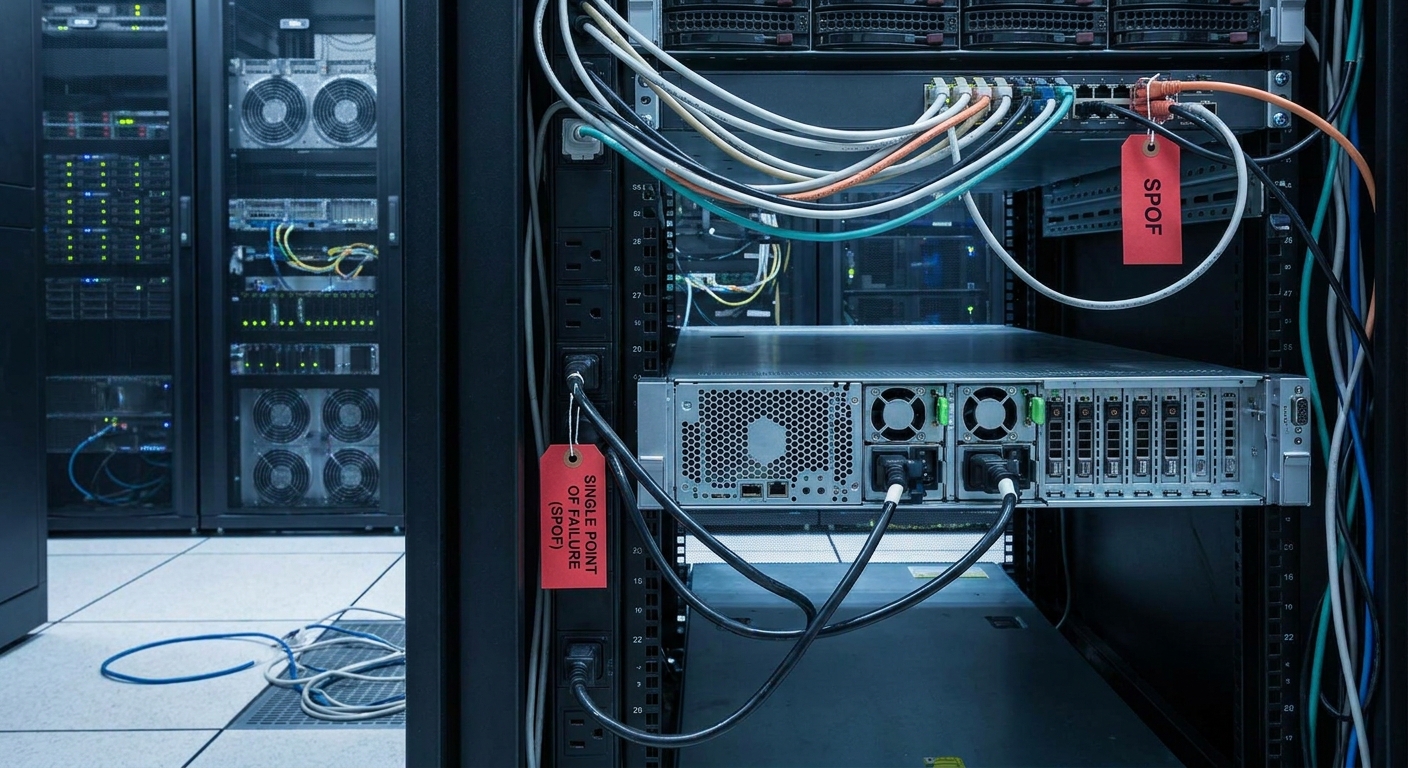
Welcome to Episode 27 of Architecting Zero Downtime Infrastructure! Today, we’re going on a bit of a treasure hunt. We’re looking for something that’s incredibly dangerous, surprisingly common, and often hiding in plain sight: The Single Point of Failure Hiding in Your Server Rack.
Now, what I often see in the field is a massive, and frankly correct, investment in redundancy at the application and server level. Teams build these incredibly resilient systems—clustered databases, load-balanced front-ends, you name it. And that is exactly the right approach. But I often find there’s a blind spot.
We focus so intently on the virtual machines and the code that we forget the humble hardware holding it all together. So, let me pose a question for you… when was the last time you walked over to one of your racks and really considered the resilience of the Power Distribution Unit? Or the top-of-rack network switch?
My experience tells me that often, the most significant threat to your service is the very component you haven’t thought about in years.
What Exactly Is a Single Point of Failure?
Let’s start by being very clear about what we’re looking for. A Single Point of Failure, or SPOF, is any part of a system that, if it fails, will stop the entire system from working. It’s that simple, and that dangerous.
The way I often explain it to clients is to think about the plumbing in a house. You can have the best faucets and the strongest copper pipes, but if that single main water valve coming into the building fails or is shut off, the entire house goes dry. That valve is a classic single point of failure.
When we translate that into the data center, our minds tend to jump to a server crashing or a hard disk failing. But the overlooked risks are far more fundamental. We’re talking about a single power cable, a single network switch, or even a specific circuit breaker. The foundational work is simply to identify them. You can’t mitigate a risk you haven’t seen.
The Most Common Culprit: Power
Let’s start with the most obvious physical culprit. A server with a single Power Supply Unit (PSU) is the classic example. It’s the lowest bar for resilience, and frankly, in any production environment, I expect to see dual power supplies in every single server.
But it’s painfully easy to get a false sense of security. You can have a whole rack of dual-PSU servers and still have a massive SPOF. Let me paint a vivid picture for you.
I remember working with a financial services company. They had spent millions on a fully redundant, high-availability cluster. Every server had dual power supplies, dual network cards, dual everything. But one Tuesday morning, the entire platform went dark. All at once. After a frantic investigation, the cause was found: a facilities engineer, working on a completely unrelated task two aisles away, tripped a single circuit breaker. The breaker that just happened to power their entire ‘redundant’ rack.
Your resilience is only as strong as your most fundamental connection to the power grid.
This brings me to what I often call the hidden villain in the rack: the Power Distribution Unit, or PDU. A basic PDU is a classic SPOF. If its own internal breaker trips or the electronics inside fail, every single device plugged into it loses power. Instantly.
The most common configuration error I see involves those dual-power-supply servers. Teams will correctly specify redundant PSUs but then plug both power cords into the same PDU for convenience. And that, right there, undermines the entire investment. When that one PDU goes offline, both paths to power are severed, and the server goes down.
The Solution: True A/B Power Resilience
So, how do we solve this properly? The industry standard, and the only configuration I consider acceptable for production systems, is a design built around A/B power feeds.
Think of these as two completely independent power circuits delivered to your rack. They should come from different distribution boards and be protected by different breakers. They are entirely separate paths from the utility room to your hardware.
The implementation is straightforward, but it requires discipline:
- Install two separate PDUs in the rack. One is the ‘A’ PDU, and the other is the ‘B’ PDU.
- Connect the ‘A’ PDU exclusively to the A-side power feed.
- Connect the ‘B’ PDU exclusively to the B-side power feed.
Now for my unbreakable rule: For every dual-power-supply server, you plug one power cord into the ‘A’ PDU and the second cord into the ‘B’ PDU. That’s it.
Now you have true fault tolerance. You can lose an entire feed, an upstream breaker can trip, or one of the PDUs can fail… and your server will continue humming along, uninterrupted, on the remaining supply. That is the foundation of a resilient rack.
The Other Hidden Villain: The Network
Now that we’ve established a solid power foundation, let’s turn our attention to networking, because there’s another hidden villain that operates on exactly the same principle: the Top-of-Rack (ToR) switch.
In many configurations, every single server in that rack plugs into one switch for its network access. You can probably see where this is going. That switch becomes a massive single point of failure. It doesn’t matter how resilient your servers are; if that one piece of hardware fails—from a hardware fault, a power issue, or even a firmware update that goes wrong—the entire rack is effectively cut off from the world.
You’ve created an island. Your applications might be running perfectly, but if they can’t speak to the network, they’re useless.
The solution mirrors our approach to power. It’s about creating parallel, independent paths. My personal rule of thumb for a production rack is to have two Top-of-Rack switches, a Switch A and a Switch B.
Each server should then have at least two network interface cards (NICs). The cabling discipline is simple but critical: one NIC plugs into Switch A, and the other plugs into Switch B. The final piece is configuring the server’s operating system to bond or team these two physical connections into a single, logical one. The OS is smart enough to see both paths and will automatically failover if one link disappears. The result? You can take an entire switch offline for maintenance, and not a single server in that rack loses its connection.
Don’t Forget the Human Element
We’ve addressed the hardware, but I’ve seen perfectly designed racks fail because of something else. The single point of failure isn’t always a device… sometimes, it’s a person or a process.
I’m talking about the ‘hero engineer’—the one person who knows how everything is configured and holds all the critical passwords in their head. That individual is a huge organizational risk. What happens if they’re on a plane or leave the company?
This risk extends to process. When I walk a data center floor, I’m looking for discipline. Unlabeled cables—what we call ‘cable spaghetti’—are a process failure waiting to happen. It makes it far too easy for a well-meaning engineer to unplug the wrong server during a high-pressure incident. If your rack’s diagrams are out of date, you’re flying blind in an emergency.
Technology alone doesn’t create resilience. It’s the disciplined processes and shared knowledge that truly keep your systems online.
Your Turn: A Quick Rack Audit
Let’s make this practical. I encourage you to perform a simple audit on one of your own racks, maybe this afternoon. Here’s my process:
- Start with Power: Pick one critical server. Does it have two power supplies? Good. Now, physically trace both power cords. Does one connect to a PDU on the left and the other to a PDU on the right? If both land in the same unit, you’ve found your first job.
- Move to Network: Trace the network cables from that same server. Are there at least two? Do they go to two different Top-of-Rack switches? This is what you’re looking for.
- Step Back and Look: Is the cabling neat and clearly labeled? Can you find the documentation for this rack’s layout in under 60 seconds?
These are the simple, physical checks that define a truly resilient system.
Tying It All Together
If there’s one thing to take away from our discussion today, it’s that true resilience requires thinking beyond the server. It means looking at the entire rack as an ecosystem. The most common single points of failure are rarely in the software; they’re in the fundamental infrastructure.
We’ve covered the single PDU that takes down a rack of otherwise redundant servers and the single top-of-rack switch that creates an island. The solutions, as we’ve discussed, are about discipline and design: implementing proper A/B power from separate sources and using dual, independent network switches for every rack. These are the practices that separate a fragile system from a truly robust one.
Thank you so much for joining me for Episode 27! I really appreciate your time and attention.
Join me next time for Episode 28, where we’ll get into one of the most important concepts in our field: ‘What ‘Five Nines’ Really Means: Calculating Uptime and Its Business Impact’.
As always, I’d love to hear from you. Have you ever been bitten by a hidden SPOF? Share your stories or questions in the comments below!
Leave a Reply